

This question is fair enough and PingMaster proposes the following business model.
Ping testing is of most benefit to those customers who are prepared to pay the most for the highest ping bats. High ping bats are rare and with rarity comes price. This is the same as “Players Grade 1+” bats that amount to <1% of all bats on the market and which command prices of >AUD$1500. The difference here, is that Players Grade bats are priced based on how they look, rather than how they perform. However, most cricketers don’t care how the bat looks, they care how it performs.
A bat that is ping tested is not the same as one that hasn’t been tested.
The manufacturers recommended retail price (RRP) is for a bat with unknown performance. A PingMaster tested bat has known performance. It is now not the same product. The manufacturers RRP no longer applies for a PingMaster tested bat.
All bats that have been tested with PingMaster can be re-valued according to their ping levels. An example might be the best way to explain.
Lets assume a bat retailer has 40 bats available with the following range of RRPs, based on different grades of willow
8 x AUD$300, 8 x AUD$500, 8 x AUD$700, $8 x AUD$900 and 8 x $1100 bats.
The following total revenue for all 40 bats would be
AUD$2400+ AUD$4000 + AUD$5600 + AUD$7200 + AUD$8800 = $28,000
The average bat RRP for all 40 bats is AUD$28,000 / 40 = AUD$700.
Lets take 4 bats from each RRP band and have them ping tested. We now have 20 original bats with an expected total revenue of AUD$14,000 and 20 PingMaster tested bats, which we can now re-value based on ping, as the original RRP was for untested bats.
We would expect that there will be some range of ping, that would be similar to the following normal-distribution, bell-curve that looks like this.

The following PingMaster data was obtained using 24 used bats and 24 new bats. The distribution of ping follows the normal, bell-curve profile. There will be a small proportion of low-ping bats, a larger proportion of average-ping bats and small proportion of high-ping bats.
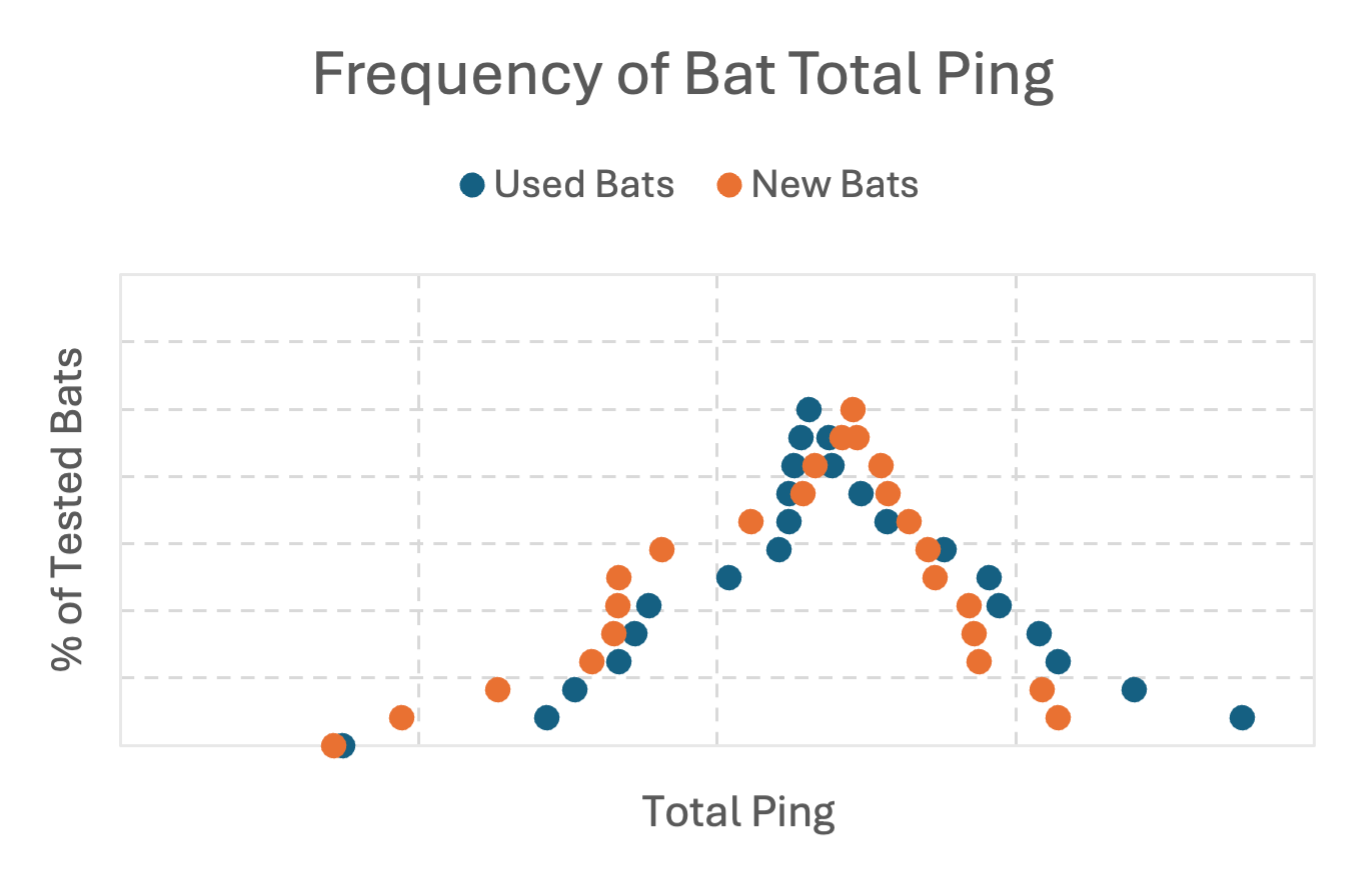
The new RRP of ping tested bats can be priced accordingly, with the cost of the PingMaster testing factored in. The difference is now that customers can have confidence in the performance of the bat they are buying and customers are prepared to pay a premium for known bat performance.
For the 20 PingMaster tested bats, the new RRPs for these bats could be as follows
3 x AUD$330, 5 x AUD$550, 5 x AUD$800, 4 x AUD$1100, 3 x AUD$1300
The total revenue for all 20 PingMaster tested bats would be
AUD$990+ AUD$2750 + AUD$4000 + AUD$4400 + AUD$3900 = $16,040
The average bat RRP for all 20 PingMaster tested bats is AUD$16,040 / 20 = AUD$802.
The cost of PingMaster testing would be much less than the additional $2,040 in revenue received. Even if the 3 x AUD$330 low ping bats weren’t sold, the additional revenue would still be more than the untested bats.
In this example, the highest ping bats are still being sold for less than RRP’s for Players Grade bats with unknown performance. It would be reasonable to suggest that these highest ping bats should be priced higher than AUD$1500 for, rare, high-ping bats. Therefore, total revenue expectations are likely conservative in this example.
Customer feedback has indicated that cricket players want a level of certainty in their bat. If they cant afford the highest ping bats, they want the best bats they can afford.
Some players, however, can only afford the lowest price bats, so they will still buy the cheapest, AUD$300 untested bats, until they are sold out. Then they will move to the AUD$330 ping-tested bats.
This is why it would be of value to have a proportion of bats that are not tested for ping. These cheapest bats will continue to appeal to the budget-conscious customer that either cant afford a higher priced bat, or simply don’t need a high performing bat in the first place.